‘Growth Hacking’ has become a buzzword in business, particularly among millennials and entrepreneurs. A growth hacking strategy is a dynamic approach that entrepreneurs adopt to accelerate business growth rapidly, especially when operating on a tight budget. Since around 2010, this term has gained immense popularity due to its effectiveness in scaling ventures efficiently.
What Is a Growth Hacking Strategy?
A growth hacking strategy is a modern alternative to traditional marketing methods, which were often time-consuming and costly. This approach focuses on crafting efficient marketing methodologies to enhance business performance and revenue. It encompasses a variety of actions, including:
Social media marketing
Product & data strategies
Performance analysis
Data testing
Lean marketing
Product development
Customer acquisition
Customer retention
Who Is A Growth Hacker?
A growth hacker is a professional dedicated to formulating personalized growth hacking strategies for comprehensive business development. These experts consider elements like SEO optimization, social media marketing, website configuration, and other growth hacking strategies. A growth hacker employs unique approaches aligned with your business goals, from developing well-analyzed hypotheses to creating designs for ongoing progress. Their focus revolves around acquiring and retaining customers at a low conversion rate, utilizing avenues such as:
Content Marketing
Product Marketing
Advertising
Website optimization
Customer acquisition
If you’re aiming for blitz growth, a well-crafted growth hacking strategy is the key to unlocking rapid business expansion and success.
Unlocking Growth with Strategic Hacks
Growth hacker marketing is a strategic beacon to propel businesses to the summit. The harsh reality is that many beloved cafes or homemade coffee brands close their doors due to a need for more scalable growth translated into profits. The antidote lies in deploying a growth hacking strategy that positions your business as the preferred choice, prominently showcased on leading social media platforms. In a fiercely competitive market, capturing attention and ensuring customer return is paramount.
Growth Hacking Examples: Airbnb and Dropbox
1. The Iconic Airbnb Growth
When contemplating growth hacking, the illustrious story of Airbnb immediately comes to mind. Transforming into a global phenomenon, Airbnb revolutionized the travel industry. In its nascent stage, Airbnb strategically leveraged Craigslist, recognizing it as the hub for its target audience seeking alternative lodging. The ingenious move allowed hosts to seamlessly share their listings on Craigslist, resulting in instant access to a vast pool of potential customers. The lesson here is clear: pinpoint the right platform, introduce the suitable feature, and strike at the opportune moment.
2. The Famous Dropbox Story
Navigating the information deluge, Dropbox provided a solution with its unique selling proposition — free storage space. Dropbox gamified its onboarding process to attract customers, rewarding existing users with additional free storage for social media engagement. Linking Dropbox accounts to Twitter and Facebook and sharing information on these platforms became a cost-free method to acquire new users. Encouraging user engagement through rewards, such as sharing files, fostered user retention. With 500 million users today, Dropbox’s growth hacking strategy is a testament to its success.
3. Masakha – Food Business Growth
UpGrowth, a distinguished growth hacking agency, has proven its mettle in delivering top-notch digital marketing and growth hacking services across diverse sectors. Among the success stories, Masakha, a specialized seafood restaurant in Pune, stands out as a testament to UpGrowth’s expertise.
Masakha’s Growth Challenges
Facing the common hurdles encountered by new restaurants, Masakha aimed not only to deliver exceptional meals but also to outshine competitors and gain visibility among potential clients. As a freshly opened establishment, creating awareness and positioning itself as a premier seafood destination were critical objectives.
Strategic Solutions Implemented
1. Local Branding through Google My Business
UpGrowth initiated the setup of a Google My Business account for Masakha, strategically promoting the brand within the local community. This step aimed to enhance visibility and attract customers in the vicinity.
2. Positioning as a Seafood Specialist
Recognizing the importance of establishing Masakha as a seafood specialist, the growth hacking strategy focused on creating a brand image aligned with delectable seafood dishes.
3. Leveraging YouTube Food Blogging Channels
To extend Masakha’s reach beyond the local sphere, UpGrowth’s team strategically promoted the restaurant on popular YouTube food blogging channels. Collaborating with food vlogging channels facilitated positive reviews and increased visibility on food delivery apps.
Impact of Growth Hacking
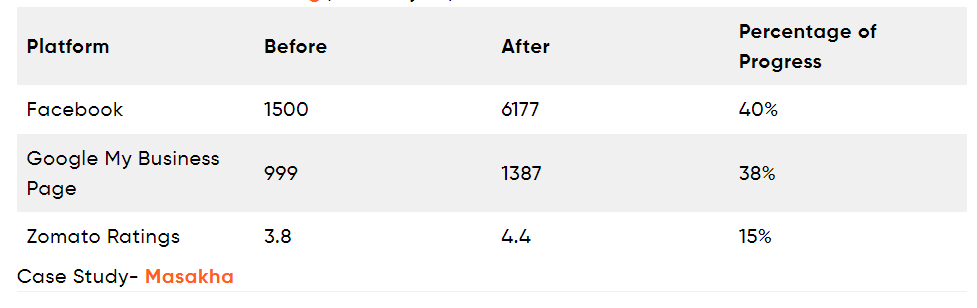
The concerted efforts of UpGrowth through strategic growth hacking resulted in a transformative impact for Masakha. The restaurant witnessed increased traffic, a surge in home-delivery orders, and a notable rise in restaurant visits. This success story exemplifies how a well-crafted growth hacking strategy can effectively address challenges and drive substantial business growth.
Here’s how our Growth Hacking positively impacted the brand:
Effective Growth Hacking Strategies Unveiled
Encompassing A/B testing
In the realm of growth hacking strategies, continuous A/B testing takes center stage. This approach is pivotal in understanding the effectiveness of different systems or campaigns for your brand. Regular testing allows businesses to stay attuned to market trends and evolving consumer needs.
Email campaigns
Additionally, a well-crafted email campaign emerges as a potent growth hacking tool. It takes time to understand the influence of impactful email content. From introducing products or services to persuading potential customers, a meticulously planned email marketing strategy holds the potential to enhance conversions significantly.
Advanced Facebook advertising
Harnessing the power of advanced Facebook advertising tools is another essential growth hacking technique. Leveraging saved audiences, custom audiences, and lookalike audiences on Facebook allows businesses to target their audience precisely. By identifying common denominators among the best clients, brands can create personalized, lookalike audiences, expanding their reach strategically.
Targeted Social media marketing
Social media marketing remains a cornerstone in growth hacking endeavors. Utilizing social media advertising tools for mass modifications, process automation, and ad optimization proves beneficial, especially when managing multiple campaigns simultaneously. Specific tools facilitate blog post promotion, attracting a broader audience.
Choosing the right social media platforms is a strategic move in growth hacking. Dominating smaller, niche social networks relevant to your industry can offer unrestricted access to your audience. Whether it’s a network for stock traders or a platform tailored for creative entrepreneurs, conquering specific social media spaces provides opportunities to maximize audience potential.
These growth hacking strategies, encompassing A/B testing, email campaigns, advanced Facebook advertising, and targeted social media marketing, collectively contribute to a dynamic approach to driving business growth.
Unlocking Business Growth: Essential Growth Hacking Tools
To stay competitive in the digital landscape requires leveraging the latest growth hacking tools and apps designed to simplify the lives of digital marketers. These tools are crucial in enhancing web exposure, gaining marketing insights, and optimizing various aspects of business growth. Here’s a snapshot of some leading growth hacking tools:
SEMRush: A comprehensive toolkit catering to SEO, PPC, SMM, keyword research, competitive research, public relations, content marketing, marketing insights, and campaign management.
Google Search Console: An invaluable Google web tool enabling web admins to monitor website indexing progress and enhance overall online visibility.
HubSpot: A multifaceted platform encompassing marketing, sales, customer service, and CRM software with tools and methods to facilitate business development.
Survey Monkey: An AI-powered feedback platform allowing businesses to gather instant feedback through easily created online surveys, translating customer feedback into corporate growth.
SessionCam: A cloud-based set of tools for visualizing website visitor behavior, offering features like heatmaps, customer journey mapping, and struggle detection to enhance the user experience.
AWeber: A potent email marketing tool employing automated, results-driven email campaigns to support small business expansion.
Summing Up!
Embracing growth hacking tools and strategies is not just a choice but a necessity for modern entrepreneurs. Whether initiating a new business or managing an established one, growth hacking proves beneficial at every stage, driving conversions, increasing sales, and ensuring business growth.
FAQs
1. How can leveraging social media contribute to growth hacking?
Leveraging social media is a cornerstone of any robust growth hacking strategy. The use of social media platforms such as Facebook, Twitter, and Instagram can help businesses grow quickly. Here’s how:
Building Brand Presence:
Active social media presence builds brand visibility. Consistent posting, engagement with followers, and sharing valuable content contribute to brand awareness, a pivotal factor in growth hacking.
Targeted Advertising:
Social media platforms offer advanced targeting options. Businesses can optimize their growth hacking efforts by tailoring ads to specific demographics, ensuring their content reaches the most relevant audience.
Community Engagement:
Actively engaging with the community creates a sense of belonging. Responding to comments, running polls, and fostering discussions help build a loyal customer base, a key ingredient for sustained growth.
Influencer Collaborations:
Partnering with influencers amplifies reach. Influencers have dedicated followers, and their endorsement can swiftly introduce a brand to a vast audience, expediting growth.
2. What role does viral marketing play in growth hacking strategies?
Viral marketing is a potent element of growth hacking strategies. Crafting content that resonates with the audience’s emotions or addresses their pain points can lead to organic sharing, turning ordinary content into a viral sensation. Virality propels brand visibility and accelerates growth.
3. How can referral programs be utilized for rapid business growth?
Using referral programs can harness the power of word-of-mouth marketing, rapidly expanding the customer base and driving growth by encouraging existing customers to refer friends and offering incentives.
4. What is the importance of A/B testing in growth hacking efforts?
A/B testing is a crucial part of growth hacking, which involves comparing two versions of a webpage, email campaign, or advertisement to determine which one performs better. By systematically testing and optimizing elements, businesses can refine their strategies and achieve maximum effectiveness in their growth hacking efforts.
5. How can optimizing the onboarding process lead to accelerated business growth?
The onboarding process is crucial for user retention. Streamlining the user’s first interactions with a product or service enhances their experience, increasing the likelihood of conversion and long-term engagement. An optimized onboarding process ensures a positive first impression, paving the way for accelerated business growth.
For Curious Minds
A growth hacking strategy is a dynamic and data-driven methodology designed to achieve rapid business expansion on a minimal budget. Unlike traditional marketing, which often relies on established, costly channels, growth hacking prioritizes lean, test-oriented tactics across the entire customer journey, from acquisition to retention. Its core is about finding scalable growth through unconventional means.
The key differentiator lies in its holistic approach that blends marketing, product development, and data analysis. A growth hacker's objective is to identify the most efficient ways to grow a business by focusing on:
Cross-functional tactics that integrate marketing with product features, like the referral program that helped Dropbox gain millions of users.
Rapid experimentation involving A/B testing, data analysis, and performance marketing to quickly identify what works and what does not.
Full-funnel optimization, which goes beyond simple customer acquisition to include activation, retention, referral, and revenue.
This agile mindset allows startups to compete with established players by being smarter and faster. Understanding these foundational principles is the first step toward building your own growth engine.
A growth hacker is a hybrid professional who combines the analytical mind of a data scientist with the creative instincts of a marketer and the technical understanding of a product manager. Their unique value comes from focusing relentlessly on a single metric: growth. They are not just marketers, they are engineers of scalable business development.
A successful growth hacker possesses a T-shaped skill set with deep expertise in one or two areas and broad knowledge across many others. Their work revolves around:
Data Analysis: Constantly tracking performance metrics to form and validate hypotheses for growth experiments.
Channel Expertise: Mastering platforms and techniques like SEO, social media marketing, and content marketing to find low-cost acquisition channels.
Product Integration: Working with development teams to build growth mechanisms directly into the product, as seen in the Airbnb example.
This integrated role is vital because modern growth is not siloed. A successful strategy requires a deep understanding of how a website's configuration impacts SEO and how product features can drive referrals. To see how these skills translate into tangible results, exploring case studies reveals their direct impact on business outcomes.
Airbnb's Craigslist integration was a platform 'piggybacking' strategy, while Dropbox's model was a viral loop built on user incentives. The former taps into a pre-existing community, and the latter creates a new one through network effects. Choosing between these depends entirely on your product and target audience.
The decision requires evaluating several factors:
Audience Location: Does your target audience already congregate on a specific platform like Craigslist, Reddit, or a professional forum? If so, an integration strategy like Airbnb's could provide immediate access.
Product Value Proposition: Is your product's value enhanced when more people use it? For a product like Dropbox, which thrives on file sharing, a referral program that rewards both the sender and receiver is a natural fit.
Technical Feasibility: A platform integration may require significant technical resources, while a referral program can be simpler to implement.
Airbnb needed to solve a two-sided market problem (hosts and guests), making Craigslist ideal. Dropbox needed to encourage widespread adoption of a new behavior, making a viral loop more effective. A deeper analysis of these classic examples can clarify which path is right for your venture.
Airbnb's legendary growth hack involved creating a simple, unauthorized tool that allowed its hosts to cross-post their property listings to Craigslist with a single click. This move was brilliant because it directly addressed their biggest challenge: a lack of marketplace liquidity. By tapping into Craigslist, they gained instant, free access to a massive audience actively searching for alternative accommodations.
This strategy demonstrates the power of finding and building a bridge to where your customers already are. The key elements of its success were:
Audience Alignment: They correctly identified Craigslist as the primary hub for their target demographic at the time.
Frictionless Experience: The tool made it effortless for hosts to expand their reach, providing immense value with minimal effort.
Scalable Distribution: It was a low-cost, high-impact way to put the Airbnb brand and its listings in front of millions of potential customers without a traditional advertising budget.
This case proves that the most powerful growth channels are often hidden in plain sight. Learning to identify these opportunities is a critical skill for any entrepreneur looking for rapid growth.
Dropbox's growth was famously fueled by a two-sided referral program that rewarded both the referrer and the new user with extra free storage space. This approach transformed its user base into a powerful, self-perpetuating marketing engine. By making storage a currency, they gamified the sharing process and incentivized viral growth directly within the product experience.
The program was successful because it was built on sound psychological and strategic principles:
Mutual Benefit: Unlike one-sided programs, rewarding both parties made users feel like they were giving a gift to their friends, not just exploiting them for personal gain.
Core Product Value: The reward (more storage) was directly tied to the product's core utility, encouraging deeper engagement and retention.
Simple Onboarding: The process of inviting friends and claiming rewards was seamlessly integrated into the user experience, from setup to social media sharing.
This strategy was so effective it drove millions of sign-ups, helping Dropbox reach its 500 million users milestone. This case remains a masterclass in building marketing into the fabric of your product.
For a specialized local business like the seafood restaurant Masakha, a growth hacking agency such as UpGrowth would focus on hyper-local, data-informed tactics to stand out. The goal is to bypass the high costs of traditional advertising by creating targeted campaigns that drive both foot traffic and online orders. This involves a multi-pronged strategy that builds community and maximizes visibility where it matters most.
A typical plan would include:
Hyper-Local SEO: Optimizing the restaurant's online presence to dominate search results for terms like 'seafood in Pune' on Google Maps and local directories.
Social Media Engagement: Running targeted ad campaigns on platforms like Instagram and Facebook, showcasing high-quality food photography to users within a specific radius of the restaurant.
Customer Retention Programs: Implementing a loyalty program or exclusive offers for repeat customers, turning them into advocates.
The challenges Masakha faced are common, but a focused growth strategy turns them into opportunities. A deep dive into such local business case studies can reveal a playbook for achieving scalable success.
For a new D2C brand, the first priority is to achieve product-market fit and generate initial traction without exhausting capital. A growth hacking approach focuses on building a repeatable, low-cost customer acquisition engine. This starts with deep customer understanding and rapid, small-scale experiments before scaling up.
Here is a three-step plan to begin:
Identify a Niche Channel: Instead of a broad social media push, find one platform where your ideal customers are highly concentrated and underserved. This could be a specific Subreddit, a niche Facebook group, or an influencer's community. Master this channel first.
Develop a 'Value-First' Content Strategy: Create content that solves a problem or provides unique value for your audience, with your product as a natural part of the solution. This builds trust before you ask for a sale, similar to how Dropbox offered free storage.
Implement a Data-Feedback Loop: Use free tools like Google Analytics to track user behavior from your chosen channel. Measure everything from click-through rates to on-site engagement to understand what is working, then iterate quickly.
This methodical approach ensures your limited budget is spent on proven tactics. Exploring more detailed implementation guides can provide the tools you need for each step.
Replicating the outcomes of giants like Airbnb means adopting their experimental mindset, not just copying their tactics. The key is to develop a systematic process for generating, prioritizing, and testing growth ideas that are unique to your business. This disciplined approach turns growth from a guessing game into a science.
A simple process for this is:
Formulate a Hypothesis: Start with an educated guess based on data and customer insights. Structure it clearly: 'We believe that [action] for [target audience] will result in [expected outcome] because [reason].' For example, 'We believe that offering a free sample to first-time website visitors will increase our email sign-up rate by 15%.'
Define Success Metrics: Determine exactly how you will measure the result. This must be a quantifiable metric, such as conversion rate, user retention, or referral sign-ups.
Run a Minimum Viable Test: Design the smallest, fastest experiment possible to validate or invalidate the hypothesis. Avoid over-engineering the solution until you have proof that the core idea works.
This cycle of hypothesizing, measuring, and learning is the engine of all successful growth hacking. The full article explores how to build this process into your company's DNA.
While the tactics of early growth hacks like Airbnb's Craigslist integration may be outdated, the underlying principles remain highly relevant. Today's entrepreneurs must adapt these principles to a more complex and competitive environment. The focus has shifted from finding simple loopholes to building sustainable, community-driven growth systems.
Modern adaptation requires focusing on:
Community-Led Growth: Instead of just piggybacking on platforms, the goal is now to build or embed within authentic communities on platforms like Discord, TikTok, or specialized forums. The principle is the same, find your audience, but the execution is more about engagement than simple integration.
Product-Led Growth (PLG): The product itself must be the primary driver of acquisition, conversion, and expansion. This is the evolution of Dropbox's referral model, where features are designed to create natural advocacy and upselling.
Brand and Narrative: In a noisy market, a strong brand story is a competitive advantage. Growth is no longer just about clever hacks, but about creating a narrative that resonates deeply with a target audience.
Success today demands a more sophisticated blend of creativity, data, and brand building. Understanding this evolution is key to developing a strategy that works now, not a decade ago.
The future of growth hacking is shifting from a singular focus on acquisition to a more balanced emphasis on long-term retention and expansion. As channels become saturated and more expensive, the most sustainable growth comes from the customers you already have. This evolution requires a deeper integration of growth principles across the entire customer lifecycle.
Key shifts in focus will include:
Retention-Focused Onboarding: Designing the initial user experience to guide customers to their 'aha' moment as quickly as possible, ensuring they see the product's value and stick around.
Engagement Loops: Building features that encourage repeat usage and deeper investment in the product, turning casual users into power users. This is an extension of the ideas used by Dropbox to keep users active.
Revenue Optimization: Experimenting with pricing, upselling, and cross-selling strategies to maximize the lifetime value (LTV) of each customer, making the initial acquisition cost more sustainable.
The next wave of growth hackers will be retention experts. To prepare for this shift, businesses should explore strategies that foster loyalty and advocacy from day one.
The common failure of businesses that have initial buzz but cannot scale stems from a lack of a systematic process to convert attention into profitable, repeatable customer acquisition. A growth hacking strategy directly addresses this by creating a data-driven engine for growth. It moves beyond hope and popularity to build a predictable system for attracting and retaining customers.
It solves this problem by focusing on:
Scalable Channels: Identifying and optimizing marketing channels that can grow with the business, rather than relying on one-off PR hits or word-of-mouth that may plateau.
Unit Economics: Focusing intensely on metrics like customer acquisition cost (CAC) and lifetime value (LTV) to ensure that every dollar spent on marketing generates a profitable return.
Retention and Referrals: Implementing systems to keep existing customers coming back and encouraging them to bring new ones, as exemplified by Dropbox's successful program.
Without this disciplined approach, a business is simply riding a wave of luck. The full article provides more detail on how to build this engine.
A frequent and costly mistake is over-investing in paid advertising before achieving product-market fit or understanding unit economics. Startups often burn through cash trying to buy customers who may not stick around. Dropbox's model offers a powerful alternative by building acquisition into the product itself through user incentives.
This approach is more sustainable and effective for several reasons:
Lower Customer Acquisition Cost (CAC): Rewarding existing users with product value (like free storage) is often cheaper than paying for clicks or impressions on ad platforms.
Higher-Quality Users: Referrals from trusted friends typically lead to users who are more engaged, have a better understanding of the product's value, and are more likely to retain.
Viral Coefficient: A successful referral program can create a viral loop where every new user brings in more than one additional user, leading to exponential, low-cost growth, a key factor in reaching 500 million users.
By turning satisfied customers into an active marketing force, companies can build a growth engine that is more durable than any ad campaign. Examining these models provides a blueprint for smarter growth.
Chandala Takalkar is a young content marketer and creative with experience in content, copy, corporate communications, and design. A digital native, she has the ability to craft content and copy that suits the medium and connects. Prior to Team upGrowth, she worked as an English trainer. Her experience includes all forms of copy and content writing, from Social Media communication to email marketing.

 Growth Strategy and Planning